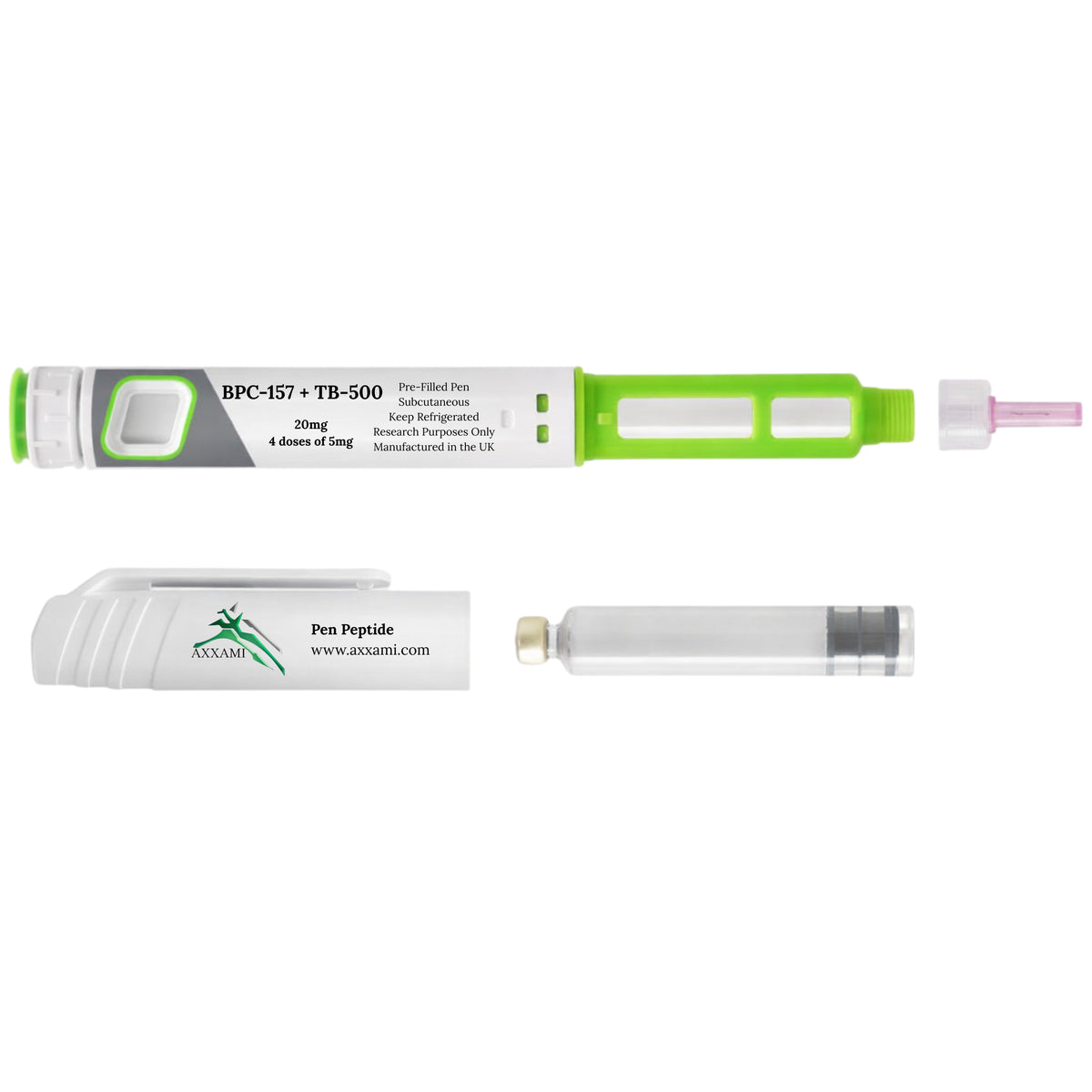
FOX04 Pre-Mixed Pen - 20mg
FOX04 Pre-Mixed Pen - 20mg
FOX04-DRI (Proxofim) is a synthetic peptide studied for its ability to act on senescent cells by disrupting FOX04-p53 interactions. In preclinical research, this mechanism has been associated with selective apoptosis of senescent cells, while preserving healthy cell populations. FOX04-DRI is primarily investigated in research contexts related to cellular aging, senescence biology, and longevity.
FOX04-DRI is a modified peptide engineered to interfere with the interaction between FOX04-DRI and p53, a key protein involved in cellular stress responses. In senescent cells, FOX04-DRI binds to p53 and prevents apoptosis, allowing these damaged cells to persist. FOX04-DRI competitively disrupts this interaction, which could restore apoptotic signalling specifically in senescent cell populations.
Senescent cells accumulate over time and are characterized by altered gene expression, resistance to apoptosis, and secretion of inflammatory mediators, collectively known as senescence-associated secretory phenotype (SASP). FOX04-DRI has been studied in preclinical models to examine the selective removal of these cells. cells. Formulated in a stabilized pre-mixed injection pen. Intended exclusively for laboratory and research use.
- Benefits:
§ Alters the survival network of senescent cells:
Senescent cells enter a state of permanent growth arrest but resist apoptosis despite the accumulation of DNA damage and oxidative stress. One of the mechanisms underpinning this resistance is the interaction between FOX04-DRI and p53 within the nucleus. FOX04-DRI is designed to interfere with this specific protein-protein interaction. By binding competitively to FOX04-DRI, it prevents FOX04-DRI from hijacking p53, thereby restoring the cell's intrinsic apoptotic signalling capacity. This mechanism does not broadly stimulate cell death, but instead targets a survival dependency characteristic of senescent cells. The selectivity of this alteration is essential for its positioning in seno lytic research.
§ Reactivates p53-driven apoptotic pathways:
Senescent cells secrete inflammatory cytokines, chemokines, growth factors, and proteases, collectively known as senescence-associated secretory phenotype (SASP). Persistent SASP signalling contributes to local tissue dysfunction and chronic inflammatory microenvironments in models of aging. By eliminating senescent cells in preclinical systems, FOX04-DRI indirectly reduces the source of SASP factors. This reduction can influence extracellular matrix remodelling, immune cell recruitment, and paracrine signalling in surrounding tissues. The modulation of this inflammatory microenvironment is a central theme in research on aging.
§ Reduces the burden of senescence-associated secretory phenotype:
Senescent cells secrete inflammatory cytokines, chemokines, growth factors, and proteases, collectively known as senescence-associated secretory phenotype (SASP). Persistent SASP signalling contributes to local tissue dysfunction and chronic inflammatory microenvironments in models of aging. By eliminating senescent cells in preclinical systems, FOX04-DRI indirectly reduces the source of SASP factors. This reduction can influence extracellular matrix remodeling, immune cell recruitment, and paracrine signalling in surrounding tissues. The modulation of this inflammatory microenvironment is a central theme in research on aging.
§ Supports research into structural tissue rejuvenation:
The accumulation of senescent cells can deteriorate tissue architecture by altering intercellular communication and the composition of the extracellular matrix. In animal models, selective removal of these cells has been associated with improved tissue morphology and regenerative capacity. FOX04-DRI is studied in this context to examine how targeted sennolysis influences organ structure. Rather than promoting growth directly, it aims to remove dysfunctional cellular components that impede normal tissue renewal processes.
§ Activates FOX04-DRI transcription factor signaling networks:
FOX04-DRI transcription factors regulate oxidative stress resistance, metabolic adaptation, and longevity-associated gene expression. FOX04-DRI interacts within this broader signalling network by selectively targeting FOX04-DRI mediated survival mechanisms. While its primary action involves the release of p53, modulation of FOX04-DRI related pathways intersects with cellular stress response systems. This places FOX04-DRI within advanced molecular research on longevity, rather than in the categories of endocrine or metabolic peptides.
§ Selective senolytic mechanism distinct from broad cytotoxic agents:
Traditional cytotoxic compounds induce apoptosis in proliferating cells without discrimination. FOX04-DRI, on the other hand, takes advantage of a molecular dependence unique to senescent cells. Since healthy proliferating cells do not rely on sustained sequestration of FOX04–p53 for their survival, they are less affected in experimental models. This selective targeting strategy represents a precision approach to sennolysis, focused on restoring intrinsic apoptosis rather than inducing external stress.
§ Facilitates research into biological aging pathways:
Cellular senescence is considered one of the hallmarks of aging. The accumulation of senescent cells is associated with a reduction in regenerative potential and an alteration in tissue homeostasis. FOX04-DRI is being studied in preclinical models of longevity to assess how senescent cell clearance influences biological markers of aging. This includes assessing tissue resilience, inflammatory signaling, and regenerative capacity at the cellular level.
§ Operates at the level of nuclear protein interaction:
Traditional cytotoxic compounds induce apoptosis in proliferating cells without discrimination. FOX04-DRI, on the other hand, takes advantage of a molecular dependence unique to senescent cells. Since healthy proliferating cells do not rely on sustained sequestration of FOX04–p53 for their survival, they are less affected in experimental models. This selective targeting strategy represents a precision approach to sennolysis, focused on restoring intrinsic apoptosis rather than inducing external stress.
§ Contributes to experimental modeling of cell turnover:
By enabling the elimination of senescent cells, FOX04-DRI supports research into how cell turnover influences tissue balance. The balance between senescence, apoptosis, and regeneration is critical to maintaining organ function. Studying these dynamics allows researchers to explore how selective sennolysis impacts long-term structural adaptation in aging models. This makes FOX04-DRI relevant in high-level cellular systems research, rather than in traditional hormonal modulation frameworks.
Pre-Mixed Cartridge and Kit:
- 1 x Cartridge
- 1 x Peptide Cartridge Pen
- 1 x Pen Carry Case
- 4 x Pen Needle Tips
Single Mixed Cartridges (1,2 & 3) Come with:
- 1,2 or 3 x Cartridge (The cartridge is premixed with the peptide vial of your choice and Bacteriostatic Water)
- 4 x Pen Needle Tips
The single 1,2 & 3 cartridges do not come with a kit.
Handling and Storage:
- Store this product in a dry place, away from sunlight and moisture
- Keep each unit sealed when not in use
- Store at 2-8 °C to minimise freeze thaw, prepare aliquots according to your protocol
- 4 x Use only within research protocols that follow your lab’s SOPs and local regulations
For Research Use Only
This product is supplied strictly for scientific research and laboratory experimentation. It is not intended for human consumption, clinical use or any form of therapeutic application.
Couldn't load pickup availability
Out of stock
View full details